The latest studies show that there will be a shortage of over 3 million skilled workers in Germany by 2030.

About 36,000 job positions in care facilities are currently vacant. In September 2025 alone, slightly more than 70,000 positions in vocational training could not be filled.
Therefore, we need you!
There are abundant opportunities to work as a skilled professional in Germany or to participate in a vocational training program.
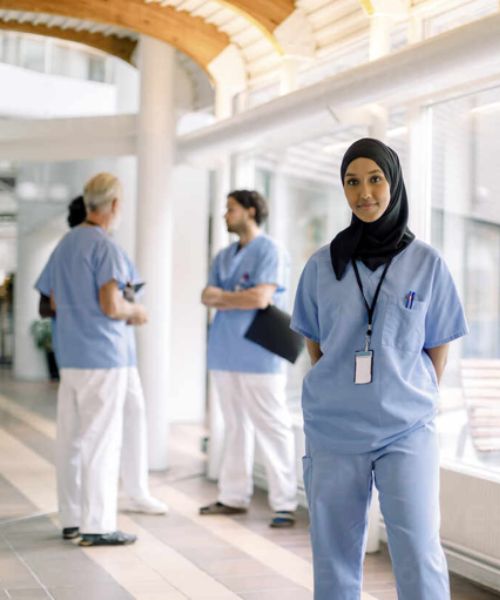
As a nurse, you will take care of people and support them in every phase of their life, which includes the following areas of responsibility:
Your tasks in the nursing field will include independent observation, guidance, support and care of patients, both inpatient and outpatient treatment.
Additionally, you may also document and evaluate nursing measures, as well as carry out medical instructions and assist with medical interventions.
However, that will depend on your individual specialisation and qualification.
While being a member of the nursing staff, you are a competent contact person for members of the patient’s family.

Thanks to the excellent living conditions in Germany, a considerable proportion of the population enjoys good health well into old age.
However, with increasing life expectancy and an ageing society, combined with the decreasing number of young people beginning their professional careers, the demand for professional nursing and basic medical care is rising.
Germany has a stable healthcare system; nevertheless, nursing professionals remain in high demand, and their contribution is more important than ever.
Hospitals, nursing homes and other care facilities are always on the lookout for nursing personnel with various levels of qualification to meet the increasing demand in the healthcare and nursing professions.
This demand is predicted to increase in the following years.
Those wishing to work in the nursing profession in Germany on a long-term basis require official authorisation to practise their profession. As a rule, the following formal requirements must be met to be permitted to work in the nursing profession in Germany:
The nursing qualification obtained in your country of origin must be recognised in Germany.
The competent authority for your case will check whether your professional qualification is equivalent to German qualifications.
If this is not the case, you could take an assessment test or go through an adaptation period to prove an equivalent level of knowledge.
The application for professional recognition can be submitted to the competent authority in the state you intend to work in. The German professional recognition obtained is valid nationwide.
Depending on the state, you will have to be competent on a level equivalent to the B2 or B1 levels of the Common European Framework of Reference for Languages (CEFR).
You must prove, through certification by a German doctor, that you are physically and mentally healthy and are, therefore, suitable for a job in the nursing profession.
In order to prove your trustworthiness, you will require proof that you do not have a criminal record. Depending on your situation, providing a certificate of good conduct from your country of origin.
* The decisive factor for recognising your qualification is not your nationality but the place where your qualification was obtained.

5 reasons for completing vocational training in Germany
Vocational training in Germany is practice-oriented, diverse and offers many opportunities: Convince yourself of the vocational training system’s advantages.
Vocational training in Germany offers a lot of variety. It combines theory and practical experience right from the start.
You will receive on-the-job training at a company, while either one or two days a week, or several weeks at a time, are reserved for vocational school, where you will learn about the theoretical principles serving as the foundation of your work.
This dual system combining theory and practice will give you an ideal start into your professional career.
Since companies across all industries are currently looking for trainees, your chances of securing a place in a vocational training programme are excellent. In September 2023 alone, slightly more than 70,000 positions in vocational training could not be filled.
When starting a vocational training programme in Germany, you will be earning money from day one. Companies will pay you a salary for the work you do as part of your course.
Vocational training may be your ticket to a career on the German labour market. Around two-thirds of all trainees get to work permanently at their companies after completing vocational training. Upon completing your programme, you will be fully qualified for your profession and earn good money. You will also benefit from the fact that you already know your company, its operations and your colleagues.
Vocational training prepares you for the future. Professionals with vocational qualifications are in high demand in the German labour market. In some fields, candidates with a vocational qualification are even more sought after than university graduates. Start a career in Germany! German companies are looking forward to your application. And who knows, you might set up your own business and take on trainees yourself one day.
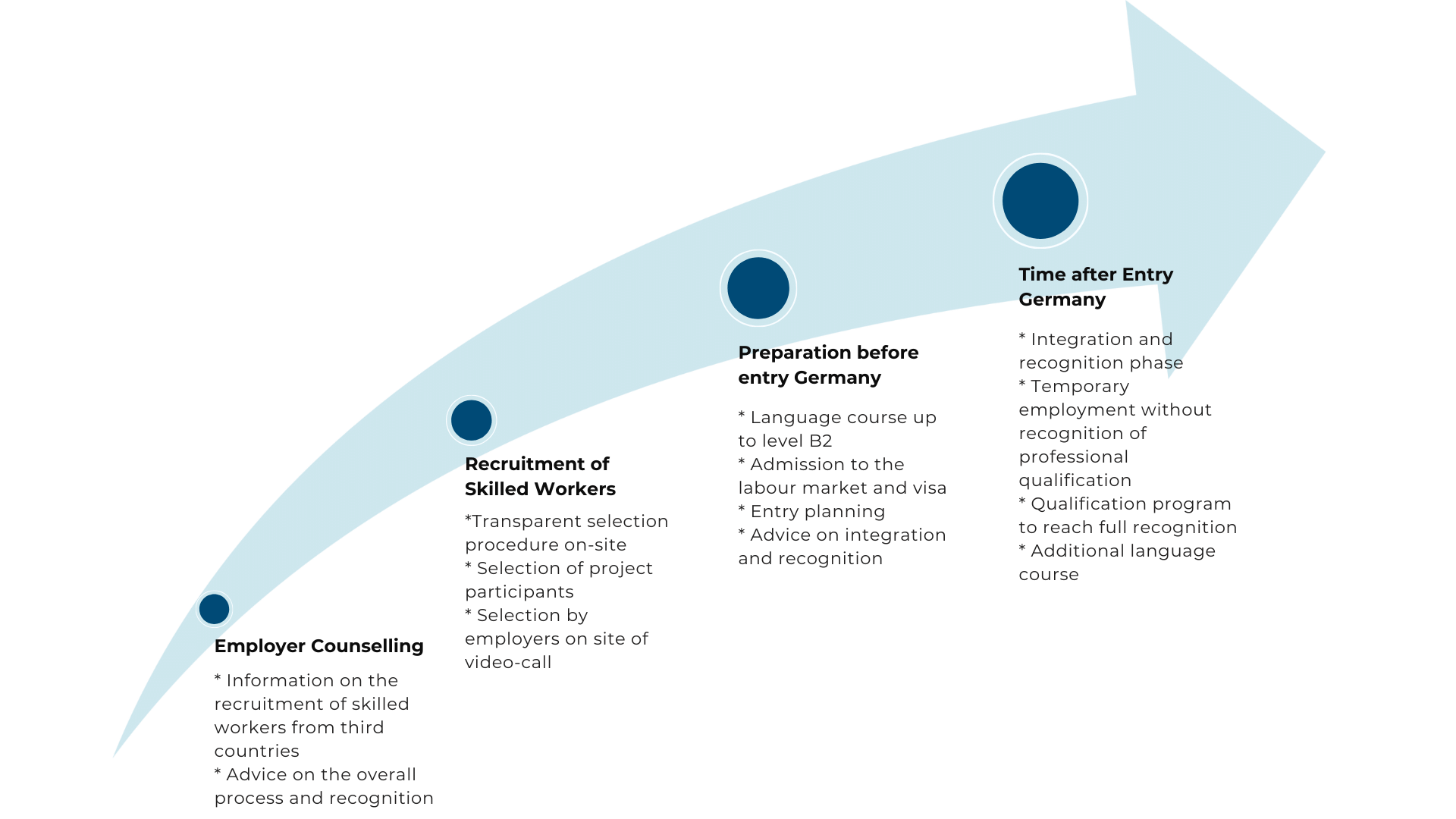
Four phases in the recruitment process